



Advantages & Properties
Applicable on almost any surface!
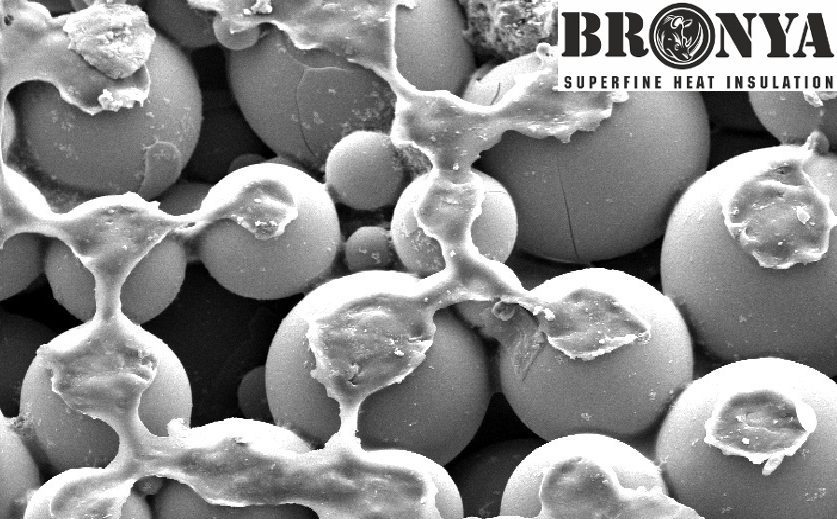
Advantages of nanoinsulation
It is applied like paint and acts as a thermal barrier! Bronya can be applied to almost any surface. After polymerization, the coating looks like a matte flexible film and has unique thermophysical properties (1 mm of Bronya coating replaces 50 mm of mineral wool or polystyrene foam), prevents heat loss and condensation, protects against corrosion, and provides burn protection for hot water pipes and equipment.
Bronya is highly effective for thermal insulation of facades, roofs (where it absolutely eliminates icicle formation), interior walls, window frames, hot and cold water pipelines, steam pipes, chimneys, various tanks, trailers, ships, etc. Bronya ceramic thermal insulation can be applied at temperatures from -60°C to +200°C (some types up to 260°C for short periods).
Properties of nanoinsulation
|
Property
|
Description
|
|---|---|
|
Cold protection
|
reduces building heating costs by up to 30%
|
|
Overheat protection
|
reflects 60-80% warmth
|
|
Soundproofing
|
A coating layer of only 0.6 mm thick reduces the noise level by up to 2 dB.
|
|
Waterproofing
|
latex which is part of the coating composition ensures low moisture absorption, no more than 0.03 g/m3
|
|
Ecological acceptability
|
do not contain toxic or harmful ingredients
|
|
Fire Safety
|
contains flame retardant ingredients
|
|
Corrosion inhibition
|
resistance to extreme weather conditions
|
|
Color customization
|
Standard paints can be applied to plasters.
|
|
It can be applied to both cold and hot surfaces.
|
The surface temperature to be coated can be from -60 to +260 °C
|
|
Ease of application
|
with a brush or a compressor
|
|
Retains thermal insulation properties for a long time
|
minimum 15 years for exterior surfaces, 25 years for interior surfaces
|
|
Saving
|
over 30% compared to classic insulation with polystyrene and mineral wool
|
Comparison - Expanded Polystyrene
Expanded polystyrene (better known as Styrofoam) is primarily used in construction as thermal insulation in all exterior structures, and as a floating floor in floor-to-floor construction. It has significantly weaker fire-resistant properties than rock wool and is not resistant to temperatures above 80°C. The primary raw material for producing polystyrene is petroleum. Polystyrene is not biodegradable. If it enters the environment, it becomes extremely hazardous. In the ground, it releases harmful substances, thereby contaminating the soil and water. Due to its light weight, it floats on water and is easily carried by the wind. Although it can be recycled, it is not cost-effective due to its light weight and large volume. As a result, all polystyrene waste ends up improperly disposed of and poses a danger to the environment. When used as thermal insulation, its flammability increases the risk of rapid fire spread and harmful gases, significantly shortening the evacuation time for building occupants. It is not vapor-permeable and does not act as a sound insulator. It also has poor mechanical strength.
- poor fire resistance, flammability, contributes to the rapid spread of fire
- high toxicity in fire
- ecologically unacceptable
- financial unviability of recycling – inability for ecological disposal – is not biodegradable
- poor vapor permeability
- Worse mechanical resistance of insulating boards
Frequently Asked Questions
With every new technology, there's a fear that its good qualities are exaggerated while its negative ones are ignored or downplayed. Here, we will list some issues we've heard so far in conversations with users.
- There are many such products on the market, how to determine which one is better?
The basic parameter that determines the quality of a thermal insulation coating is thermal conductivity coefficient whose value must be as low as possible, because lower thermal conductivity means better thermal insulation capacity. The thermal conductivity coefficient of mineral wool is around 0.045 W/mK. The thermal conductivity coefficient of Bronya thermal insulation coatings is only 0.001 W/mK. Compare the thermal conductivity coefficients of different thermal insulation materials.
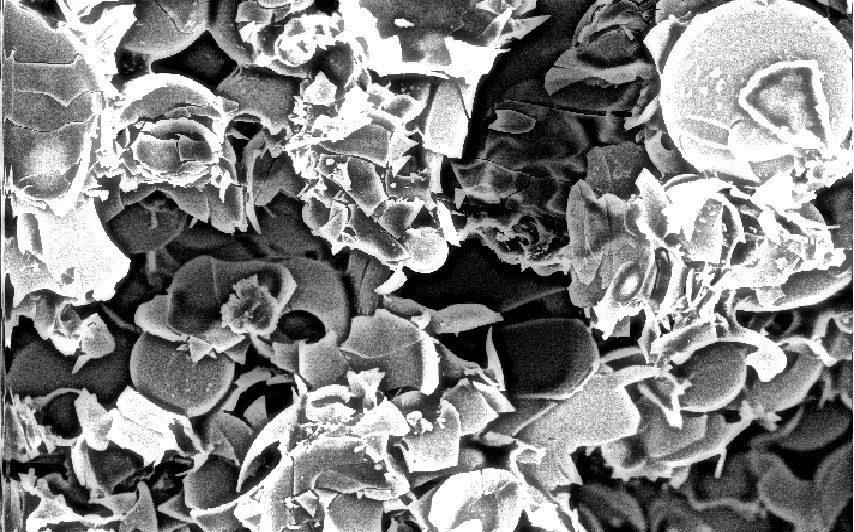
High-quality nano-thermal insulation material can be identified by looking at its structure under an electron microscope:

- What is the durability compared to classic insulation materials?
The main ingredient in Bronya nano-thermal insulation coatings are ceramic spheres, which make up to 80% of the mixture, with the remainder being binder polymers. After the material polymerizes, i.e., after drying, this material exhibits high resistance to atmospheric changes, is waterproof, and mechanically resistant. Thermal insulation of facades made with styrofoam or mineral wool must be impeccably protected from external influences. In case of any breaches, it is subject to accelerated deterioration. - Are there any drawbacks?
Due to the specific structure of such materials, the application process must be carried out expertly. Attention must be paid to substrate preparation and, in particular, to coating preparation (mixing). If the thermal insulation coating is applied with a compressor, the choice of compressor type and model should be in accordance with the specifications (exclusively airless compressors). If you wish to carry out the work yourself – consult us before starting. We will soon publish recommendations on compressor usage.