




AquaBlock Expert
Multifunctional, highly elastic polymer coating for all-weather waterproofing!
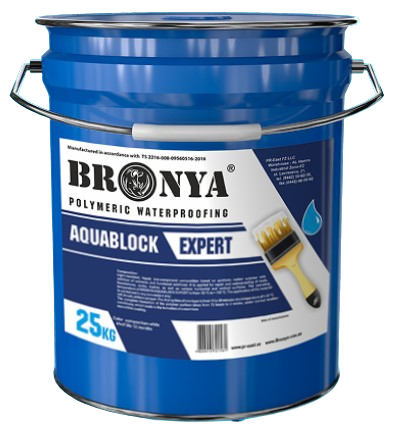
Liquid waterproofing coating
Bronya Aquablock Expert
We are pleased to inform you about the start of sales of a timeless, light-resistant, liquid, one-component waterproofing coating based on a synthetic rubber polymer with the addition of solvents and functional additives – Bronya AquaBlock Expert.
This product was created thanks to many years of experience, acquired knowledge, and the proprietary development of Bronya technology.
Where and how is it used?
Due to their excellent working properties, unique and high-tech composition, they can be applied in frost as well as in warm weather.
1. Main Application:
- Soft cladding materials
- Bitumen, bituminous masses, Onduline, and others
- Concrete, slate, roof tiles
- Black and galvanized metal
- Wood flooring, DSP, GSS, VSO, plywood
2. Waterproofing works:
- Foundation waterproofing (concrete, brick, and others)
- Hydraulic engineering works (drainage, sewage, dams, and others)
- Pools, ponds, artificial streams, and waterfalls
- Reservoirs (including potable water)
Benefits of Bronya Aquablock Expert:
- Increased grip on various surfaces, air resistance, durability, elasticity, and strength even at negative temperatures
- It is applied by all available means: brush, roller, airless sprayer
- Mixes into any color according to the palette
- All-weather application: from -25 °C to +35 °C
- Increased resistance to temperature fluctuations from -55 °C to +150 °C
- Does not require removal of old coating
- Resistance to products containing oil, acids, alkalis, saline solutions
- The coating dries quickly
- Facilitates the installation of roofing materials
- After drying, the coating is not slippery, which reduces the risk of injury.
- Expected lifespan of at least 10 years
- High coverage, low consumption
Principle of operation
When Bronya AquaBlock Expert is applied to any type of surface, the organic solvent mixture penetrates deeply into both new and existing surfaces. Based on the solvent-filled channels created, the polymer mixture of the waterproofing coating moves within the contact surface, as if blowing polymer roots. After the complete polymerization cycle, a continuous, monolithic coating is formed.
If waterproofing is applied to an old roof, it creates a polymer sandwich of the old roof and the new covering, which cannot be mechanically separated into old and new layers.