



Technology
Bronya is a next-generation ultra-fine ceramic nano-thermal insulation!
Technology
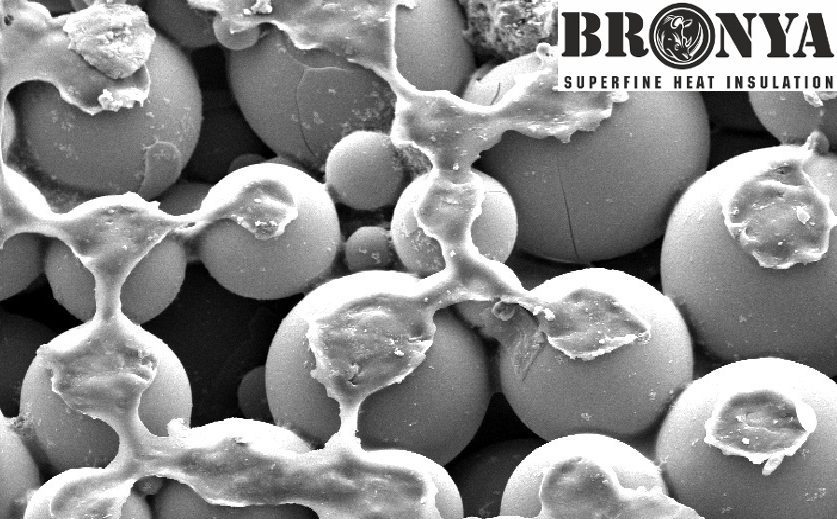
Nanotechnology is the manipulation of matter at the atomic and molecular level. Among other things, nanotechnology has enabled the production of liquid ceramic thermal insulation coatings with exceptional properties. The key ingredient of these coatings are extremely fine ceramic spheres. They are connected by special polymers – a binder material that, in the presence of light and air, transforms into a thin but extremely effective thermal insulation and anti-corrosion layer. They are applied like paint, they act as a thermal barrier!
Bronya is the finest next-generation ceramic nano-thermal insulation. It can be applied to almost any surface. After polymerization, the coating looks like a matte flexible film and has unique thermophysical properties. The thermal conductivity coefficient of Bronya ceramic thermal insulation coatings is only 0.001 W/mK (±0.0002 W/mK), which prevents heat transfer, condensation, and also protects against corrosion. For comparison, the thermal conductivity coefficient of classic materials such as styrofoam and mineral wool is around 0.05 W/mK. In addition, both styrofoam and mineral wool can lose up to 40% of their thermal insulation properties in the first year due to atmospheric influences, and they are a source of dust and allergens.
Bronya liquid ceramic thermal insulation is highly effective for the thermal insulation needs of facades, roofs (where it absolutely prevents ice dam formation), interior walls, window frames, hot and cold water pipelines, steam pipelines, chimneys, various tanks, trailers, ships, etc. Bronya can be applied to temperatures from -60°C to +200°C (some types up to 260°C for short periods).
About technology
Innovations
Volgograd Innovation Resource Center (V.I.R.C.) offers an innovative product developed by Russian scientists – a liquid ceramic thermal insulation material whose thermodynamic properties surpass those of competing materials. The facts that this material is a product of its own laboratory and made from raw materials whose producers are leaders in the global chemical industry, and that they have excellent sales results, allow this exclusive production line of superfine thermal insulation materials to be offered at an unprecedented price for this type of product.
ISO 9001-2015
Bronya thermal insulation products have numerous certifications and meet very strict technical criteria. In addition, V.I.R.C. has continuity and stability of quality – the ISO 9001-2015 certificate for the production quality management system, which guarantees uniform product quality in accordance with the specified specifications.
Bronya materials
Liquid ceramic thermal insulation consists of a high-quality binder, a special mixture of catalytic and fixing chemicals, and superfine ceramic microspheres filled with rarefied air. Special additives are added to the base mixture to prevent corrosion on metal surfaces and fungus on concrete surfaces exposed to high humidity. This combination of materials makes it lightweight, flexible, and stretchable, enabling excellent adhesion to various surfaces. In terms of consistency, the material is very similar to ordinary paint: it is a white mixture that is applied to the surface. After drying, it forms an elastic polymer film with unique thermal insulation and anti-corrosion properties. The unique thermal insulation properties are due to the strong molecular action of the rarefied air in the microspheres.
Liquid ceramic thermal insulation is a high-performance material for thermal insulation of external and internal walls, roofs, door frames, window frames, concrete floors, hot and cold water pipes, steam pipes, ventilation and air conditioning pipes, refrigeration units, various tanks, containers and tanks, trailers, refrigerated trucks, etc. It is applied to prevent condensation on cold water pipelines and to prevent heat loss on heating systems. The operating temperature of Bronya liquid ceramic thermal insulation ranges from -60ºC to 250ºC (it can briefly withstand temperatures of +260ºC). On external concrete and metal surfaces, its properties are retained for a minimum of 15 years (this also applies to continental climates with large temperature differences), and on internal surfaces – for a minimum of 25 years.
Physical principles
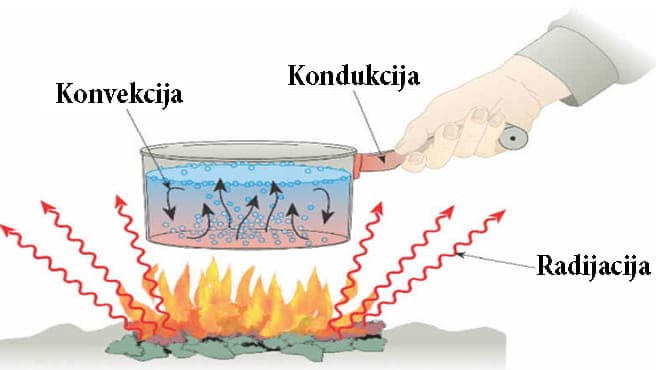
How does a material function in terms of thermophysics principles? Thermodynamics is the science that studies the laws of energy transformation and transfer. There are Three ways that heat is transferred:
- Conduction (heat transfer) – the transfer of heat through the kinetic energy of molecules and atoms between bodies in contact, from a warmer body to a cooler one.
- Convection (flow) – directed movement or flow of a fluid (liquids and gases), in which warmer fluid moves towards cooler fluid and transfers heat to the surroundings.
- Radiation (thermal radiation) – heat transfer that occurs via electromagnetic radiation; a heated body emits electromagnetic radiation, and a cooler body heats up by absorbing the radiation's energy.
These processes result in the balancing of the system's temperature as a whole. The way an insulating material blocks heat transfer and the effectiveness of this prevention, or the temperature balancing process, determines the quality of the insulation. Liquid ceramic thermal insulation material is a complex multilayered structure that minimizes all three modes of heat transfer.
Microspheres make up 80%% of the ceramic thermal insulation mixture, and only 20%% of the mixture can transfer heat through its thermal conductivity. The remaining heat is transferred by convection and radiation; since the microspheres contain rarefied air (the best insulator after a vacuum), these losses are negligible. Furthermore, thanks to its structure, the material has a low surface emissivity, which is crucial for thermophysical properties.
An insulator and thermal insulation material are not the same thing.
It is necessary to distinguish between two concepts: an insulator and a thermal insulation material, as the physical processes of heat transfer in these two materials are different.
- The working principle of an insulator is based on the thermal conductivity of the material (e.g., a mineral wool board)
- The operating principle of thermal insulation material is more based on wave physics.
The efficiency of an insulator directly depends on its thickness: the thicker the material, the better the insulation. However, due to the physical principles mentioned above, the efficiency of thermal insulation material is not directly dependent on thickness, so even a very thin layer of thermal insulation material (as little as 1 mm) functions as effective thermal insulation.