




Bronya Facade & Facade NG
It is applied to the substrate in layers 1 mm thick!

Liquid thermal insulation coating
Bronya Facade
Bronya Facade is the world's first ultra-fine ceramic thermal insulation material that can be applied in a layer thicker than 1 mm at once and has vapor permeability equal to high-quality facade paint. Bronya Facade extra-fine thermal insulation is produced specifically for concrete surfaces. Thanks to its heat reflective properties and lower operating costs compared to other thermal insulation materials, it presents itself as the best solution for professional thermal insulation.
Extra-fine Facade insulation is an extra-fine ceramic thermal insulation material that can be applied in a layer 1 to 3 mm thick (depending on application method), and whose vapor permeability coefficient is equivalent to that of high-quality facade paint (0.03). Bronya Facade is a viscous, weather-resistant mixture specially designed for the thermal insulation of vertical surfaces, including both exterior and interior walls. The coating applied to the outer and inner sides of the wall forms a unique surface and retains heat in the room, which has a positive effect on the microclimate.
Bronya Facade reflects up to 80% of the visible solar and infrared radiation spectrum. This results in significantly less building heat gain in the summer, which means significantly lower air conditioning costs, while in the winter it reduces heat loss by up to 30%. Bronya Facade thermal insulation is a durable material that adheres well to all building materials, has reflective properties, and very good vapor permeability.
General information about the advantages of Bronya ceramic thermal insulation coatings can be found at Bronya products.
Bronya Facade liquid ceramic thermal insulation is used for insulating plaster, concrete, brick, wood, and other surfaces on building facades, both internally and externally, as well as on interior walls. Bronya Facade ceramic thermal insulation can be repainted with emulsion acrylic paint or covered with wallpaper. Bronya Facade can only be tinted with paint according to our instructions and recommendations.
Bronya Facade coating:
- provides thermal insulation on both the exterior and interior sides of the wall
- increases the usability of interior space (with internal thermal insulation)
- it does not increase the load on the building structure
- insulates buildings with complex facade solutions (especially useful for renovating historic facades)
- improves thermal comfort in the space
- reduces costs and time needed for thermal insulation installation
Bronya Facade thermal insulation coating works excellent in combination with Bronya Anticor for example, for good thermal insulation of metal pipes or tanks, the required thickness of an extra-fine thermal insulation coating on a corrosion-prone metal tank is 2.5 mm. With some ceramic thermal insulation coatings, at least 6 layers would need to be applied (the first layer being an anti-corrosion primer and then 5 layers of 0.5 mm thermal insulation coating). Each layer requires 24 hours of drying. Our solution requires only three layers – the first layer of Bronya Anticor (which serves not only as an anti-corrosive agent but also as a primer and as a bonding and waterproof layer), and then 2 layers of Bronya Facade, which can be applied in layers of 1 mm thickness:
- First layer – 0.5 mm Bronya Anticor coating
- Second layer after 24 hours of drying – 1 mm Bronya Facade
- Third layer after 24 hours of drying – 1 mm Bronya Facade
Packaging and Modifications
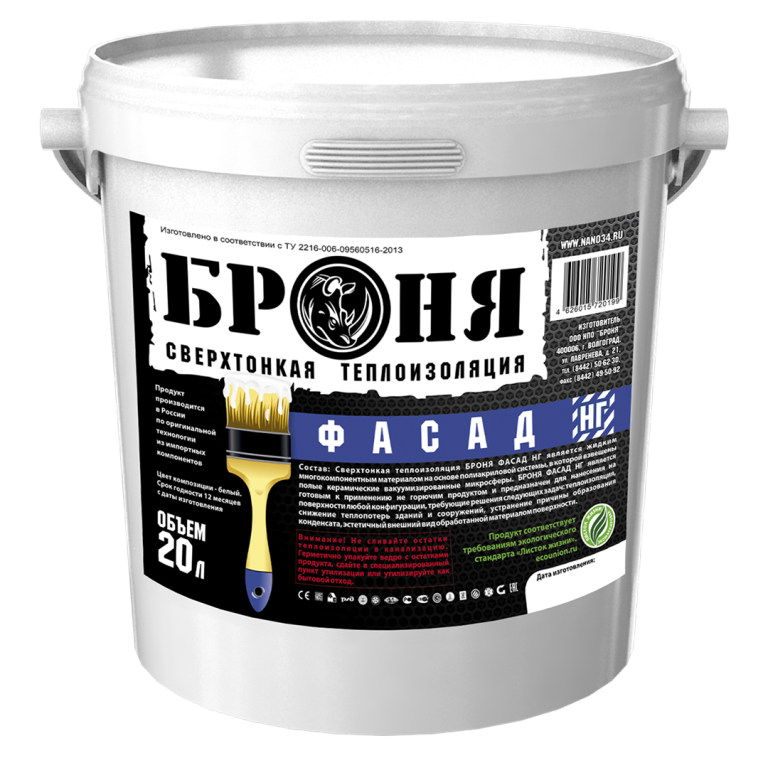
Available in 5, 10, and 20-liter packs.
There is also Non-flammable modification!
A 20L plastic bucket of Bronya Facade thermal insulation coating weighs only 9.5 kg. During proper transportation and storage, the microstructure of Bronya liquid thermal insulation remains unchanged.
Instructions for use
A) The surface should be prepared as follows: remove loose particles, grease, and seal any cracks, including grout lines between bricks, with cement plaster or gypsum, to reduce coating consumption. Remove any shiny coating from the surface by sandblasting, wire brushing, or grinding, then clean off dust. After such preparation, the surface should be rinsed with water and left to dry. If it is concrete, brick, or similar surfaces, they should first be coated 1-2 times with a penetrating acrylic coating, and allowed to dry again. The moisture content of concrete to which BRONYA FACADE is applied should not exceed 4%, and the air humidity during application should not be greater than 80%.
B) If BRONYA FACADE is to be applied to a surface prone to rusting metal, it must first be cleaned of impurities and degreased, and then coated with a layer of BRONYA ANTICOR (recommended), or some other anti-corrosive agent in 1-2 coats.
C) If BRONYA FACADE is to be applied to a rust-resistant metal surface, the glossy layer and impurities should be mechanically removed from the surface, degreased, and 1-2 coats of an anti-corrosion agent should be applied.
BRONYA FACADE is generally ready for use but can be diluted with distilled water. The amount of water added depends on the application surface temperature, air temperature and humidity, application method, and other factors. For application on surfaces with temperatures from +5 °C to +80 °C, the amount of added distilled water should not exceed 5% for brush application and not exceed 3% for compressor application. For application on surfaces warmer than +80 °C, please contact your distributor for detailed instructions. Prolonged storage may degrade thermal insulation properties.
Avoid aggressive mixing!
If you are using a drill with a mixing attachment or a specialized mixer, you must ensure that the mixing speed does not exceed 150-200 revolutions per minute. Higher mixing speeds can destroy the microspheres and significantly reduce or even negate the thermal insulation properties of the coating. Immerse the mixing attachment vertically into the bucket with the coating and mix slowly until the mass becomes homogeneous, cream-like. Mix for 3-8 minutes with a mixer or 7-10 minutes by hand. If you are coating a surface where you want to prevent condensation or frost, dilute the coating minimally and let it dry for at least 24 hours.
For coating small and/or intricate surfaces, a brush made of soft, long natural bristles is recommended. You can apply a coating to surfaces of 100 m² or more using a compressor with a working pressure not exceeding 60-80 bar.IMPORTANT !!! Read the instructions for application using a compressor). The insulating coating can be applied to a surface with a temperature from +7°C to +150°C. Avoid applying the coating in very humid weather, as the diluted material will not dry. For better adhesion of the coating, it is recommended to apply a primer prepared by diluting the coating with water to a milk-like consistency. Drying a coating layer of 0.4-0.5 mm in thickness requires at least 24 hours at an air temperature above +7°C. Only then can the application of the second layer begin.
A diluted coating layer thickness of 1 mm can be achieved with three passes of a compressor or brush. The primary layer must not be thicker, as it would then form a vapor-impermeable layer that would negate the thermal insulation properties and deform the final coating layer.
Surfaces with a temperature above +80° C should first be coated with a diluted coating to prevent boiling (Application of a 40-50% aqueous solution of the coating is recommended). IMPORTANTWhen applying BRONYA FACADE to a surface warmer than +80°C, the maximum layer thickness must not exceed 0.5 mm in 24 hours. The warmer the surface, the more diluted the coating should be. The diluted coating should be applied with short, rapid strokes in a very thin layer. Each such layer dries for at least one hour. These layers of diluted coating should be applied until it stops evaporating on the surface. Then, leave the surface to dry for 20-24 hours. After that, apply a much less diluted coating, with approximately 5-10% of distilled water.
A layer thickness of 0.4 mm can be controlled by instrument or by controlling the coating consumption of 0.5 liters per 1m², or by visual inspection (the previous layer must not be visible after coating). Material consumption depends on the surface area and application method. Consult a distributor for thermal engineering calculations and/or recommendations on the number and thickness of coatings.
Personal protection
Under normal conditions, the product is not hazardous to health. If used in a well-ventilated area or outdoors, a protective mask is not necessary. In an enclosed space, standard protective masks should be used. Use safety glasses, gloves, and protective clothing coverings. In case the coating gets into the eyes, rinse them with running water.
Critical situations
If the coating gets into your eyes, rinse them with running water for about fifteen minutes. If irritation persists, consult your doctor. If the coating gets on your skin, wash with soap and water. Protective clothing should also be washed normally. In fresh air, the liquid product is not flammable. Surfaces coated with Bronya materials should be extinguished with water, foam, dry chemicals, and carbon dioxide in case of fire. If the product spills, use any absorbent material, such as sand or earth, or rinse with plenty of water.
THE PRODUCT MUST NOT BE FROZEN DURING TRANSPORT AND STORAGE!
Store BRONYA coatings in tightly sealed containers at a temperature of +5°C to +30°C, humidity up to 80%, and protected from direct sunlight. Transportation is possible by any means at temperatures above +5°C and protected from direct sunlight. Be careful when packaging for transport: no more than 3 20L buckets may be transported stacked on top of each other, and no more than 5 10L buckets without additional packaging! Failure to comply with these rules may lead to material damage and loss of thermal insulation properties, in which case the manufacturer and distributor cannot be held liable for any malfunctions.
Approximate Calculation of Bronya Facade Thermal Insulation Coating Thickness for Wall Insulation (Recommendations)
|
Type of material the wall is made of
|
Wall thickness (mm)
|
Calculated Bronya Facade layer thickness (mm)
|
Bronya Facade layer thickness (mm) rounded
|
Approximate consumption when applied with a brush (liters/m2)
|
|---|---|---|---|---|
|
Brick
|
250
400 530 670 |
2,31
1,83 1,42 0,81 |
2,5
2 1,5 1 |
2,75
2,2 1,65 1,1 |
|
Concrete
|
250
350 |
1,65
1,33 |
1,5
1,5 |
22
1,65 |
|
Lightweight concrete
|
200
300 400 |
2,21
1,87 1,37 |
2,5
2 1,5 |
2,75
2,2 1,65 |
|
Foam concrete
|
200
300 400 |
2,04
1,56 1,22 |
2,5
2 1,5 |
2,75
2,2 1,65 |
|
Tree
|
100
150 200 |
1,72
1,47 0,64 |
2
1,5 1 |
2,2
1,65 1,1 |
|
Metal
|
0,4
0,6 0,8 |
2,13
1,78 1,54 |
2,5
2 2 |
2,75
2,2 2,2 |
Bronya Facade adheres well to most common surfaces. Because of this, even a layer thicker than 1 mm applied to a vertical surface will not slide off. The coating also has high vapor permeability, so it is used for insulating external building structures. It can be applied to surfaces at temperatures from +7°C to +120°C (the air temperature should not be below +7°C during application and during drying, which takes 24 hours for each layer). The working temperature of Bronya Facade is from -60°C to +120°C.
When working with Bronya Facade liquid insulating coating, it is essential to consider the following:
- Bronya insulation coating must not freeze
- Before opening the bucket, check that the protective seals on the lid are undamaged.
- During preparation, the coating should not be overmixed or overdiluted with water (see Coating preparation in the Instructions for use)
Technical specifications
|
Property
|
Unit
|
Value
|
|---|---|---|
|
Coating consistency
|
/
|
Smooth, uniform, white film
|
|
Coating resistance to temperature changes from -40°C to +60°C
|
Coating consistency
|
No changes
|
|
Retention of properties on external concrete and metal surfaces
(continental climate with large temperature differences)
|
Year
|
At least 15
|
|
Thermal conductivity factor of materials
|
W/m°C
|
0.001 W/mK(±0.0002 W/mK)
|
|
Material vapor permeability factor
|
mg/m³ hPa
|
0,03
|
|
Surface temperature during coating application
|
°C
|
from +7 to +120
|
|
Working temperature
|
°C
|
from -60 to +120
|
|
Coating density at 20°C
|
kilograms per cubic meter
|
600±10%
|
|
Volatile matter, maximum
|
%
|
43
|
|
Coating pH
|
pH
|
7,5-11,0
|
|
Drying and film formation time at temperature 20±2°C, minimum
|
hours
|
24
|
|
Adhesion resistance to delaminating force, minimum - on concrete surface
|
MPa
|
1,3
|
|
Adhesion resistance to peel force, minimum - on steel
|
MPa
|
2,2
|
|
Resistance of coatings to the action of 5% NaOH solution at a temperature of 20±2°C
|
Coating consistency
|
No changes
|
|
Coatings' resistance to water action at 20±2°C
|
Coating consistency
|
No changes
|
|
Coating resistance to temperatures 200±5°C
|
Coating consistency
|
No changes
|