




Bronya Light AirLess + NG
Created for use with airless sprayers!
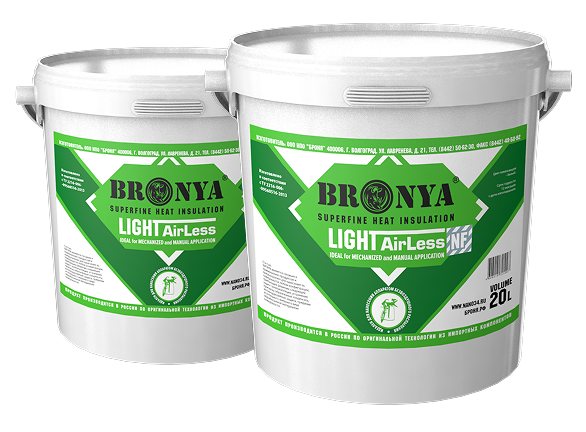
Liquid thermal insulation coating
Bronya Light Airless
Bronya Light AirLess thermal insulation coating is an innovative material for construction and finishing work. It is developed for final leveling of internal and external surfaces of concrete, brick, cement-lime plaster, gypsum boards and panels, aerated concrete, drywall, and other surfaces at temperatures from -60°C to +150°C.
The outstanding features of the Bronya Light AirLess modification, which differentiate it from other Bronya modifications, are as follows:
- The thermophysical properties of a 2-3 mm layer of Bronya Light AirLess material are identical to those of 100-150 mm thick brick masonry.
- The use of thermal insulation material is cost-effective (for solving additional winter insulation problems) compared to almost any other insulation, as the price of Bronya Light AirLess coating is comparable to the price of ordinary plasters.
- It can be used on surfaces that require light insulation (to eliminate the cold wall effect, frost penetration, and condensation formation during severe frosts), as well as in places where thermophysical properties would require less than 1 mm LCTI Bronye (Facade or Classic)
- It can be used for multi-layer coatings with the possibility of applying any building material over our thermal insulation coating.
- Work on filling and thermal insulation can be carried out simultaneously, which significantly reduces labor costs.
- The material can be applied using plaster spraying machines and airless spray guns at a pressure not exceeding 90 bar.
- The layer thickness can be up to 3 mm in a single pass.
- The layer will dry faster if the temperature is increased to 50-60 °C.
- The material can be mixed with a construction mixer at any speed
What wasn't possible before, is now possible with Bronya Light AirLess material!
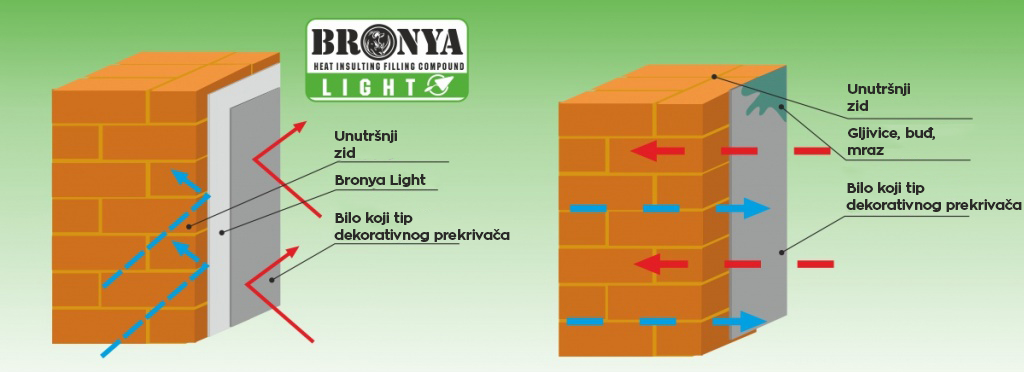
1. The walls will be insulated and plastered in one layer if Bronya Light AirLess is used.
Wall insulation is a rather complex and labor-intensive process that cannot always be carried out using conventional building materials, which are bulky and require additional labor costs for installation. The warm filling material Bronya Light AirLess can be covered with any decorative materials such as wallpaper, paint, decorative plaster, tile adhesive, etc.
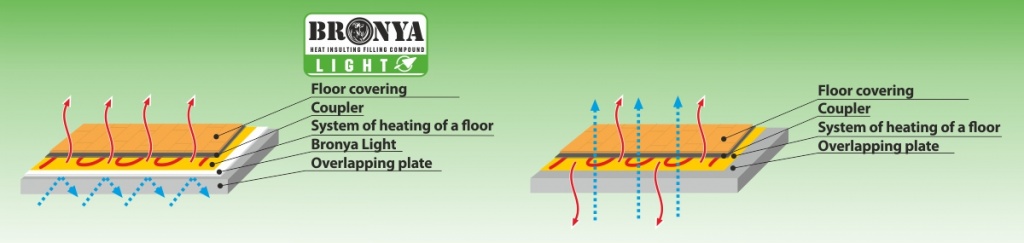
2. Floor insulation using the “underfloor heating” system”
Standard underfloor heating installation methods require an insulator between the ceiling slab and the system's heating elements, which significantly increases the layer's thickness. Now you don't have to use standard insulators that lose strength over time and shrink. Bronya Light AirLess can provide better thermal insulation than any other material and significantly reduce the thickness of the “underfloor heating” system.
Bronya Light AirLess creates a thermal barrier that prevents frost penetration from the outside and reflects heat from the heating system.
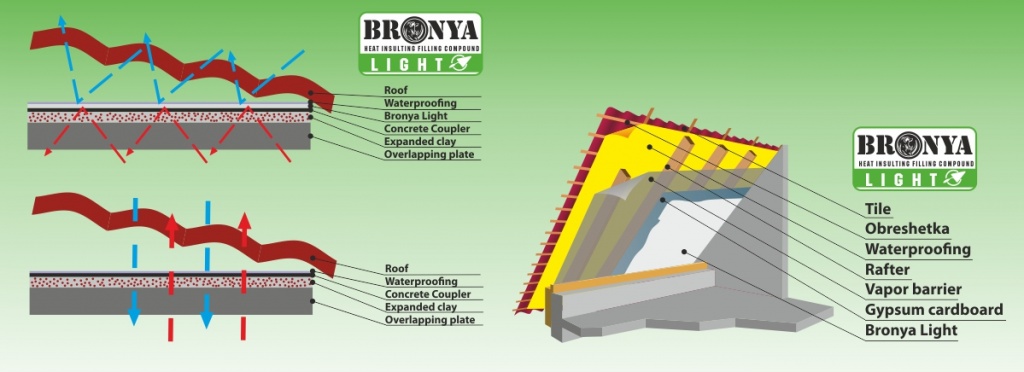
3. Roof Insulation
Bronya Light AirLess allows for roof insulation with materials that do not add weight to the structure, while simultaneously creating a thermal barrier from the external environment. Therefore, there is no heat loss, formation of internal ice, condensation, or icicles during the cold period, and heating in the warm period is significantly reduced.
Packaging and Modifications
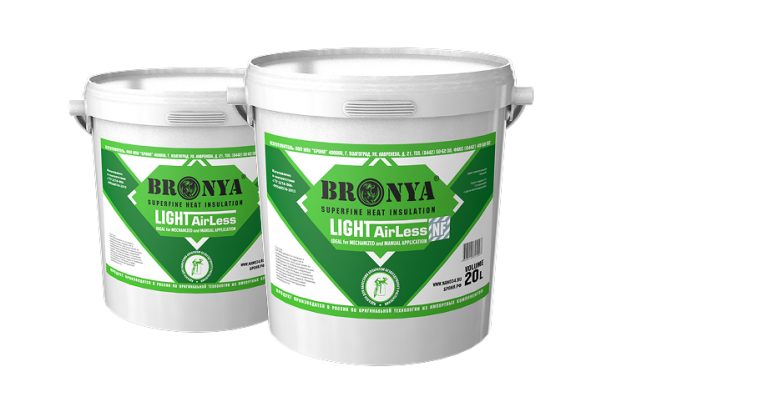
Available in 5, 10, and 20-liter packs.
There is also Non-flammable modification!
A 20L plastic bucket of Bronya Light Airless thermal insulation coating weighs only 9.5 kg. During proper transport and storage, the microstructure of the Bronya liquid thermal insulation remains unchanged.
Instructions for use
Before applying Bronya Light AirLess, it is necessary to prepare the surface for better adhesion and minimal putty consumption.
Concrete surfaces
Clean the surface of loose parts, dust, and dirt. Seal any cracks with a mixture of cement and sand. Coat the surface with one of the acrylics Bronya first u 1-2 layers to ensure better sealant penetration.
Brick surfaces
To ensure adhesion, surfaces should be cleaned of salt deposits resulting from carbonation and old paint, and then treated with a disinfectant (biocide). Apply one of the Bronya acrylic primers in 1-2 coats to ensure better penetration of the putty.
Plaster
The surface must be dry, solid, and cleaned of dust, dirt, grease, and bitumen stains. Loose parts and old paint residue must be removed. Apply one coat of Bronya acrylic primer in 1-2 layers to ensure better penetration of the filler.
Metal Surfaces
Metal surfaces should first be cleaned of rust. Clean the rust thoroughly and then coat with a metal primer or apply 1-2 coats. Bronya Anticorrosive.
Prepare the kit as follows:
Check that the bucket was properly sealed and that the security seals are intact.
Attention! Keep the kit in a closed container.
Mix the contents with a mixer at high speed for at least 15 minutes, controlling the time.
Important: High-speed stirring is permitted and recommended ONLY for Bronya Light and its modifications (AirLess, Nord).
Bronya Classic, Bronya Facade, and Bronya Anticor must not be mixed at high speed!
The material will appear to be a homogeneous mass after a few minutes of mixing, but do not rely on visual cues. Mix the material exactly according to the instructions – for 15 minutes!
Manual mixing, even for extended periods, cannot ensure the uniform consistency required to meet the described characteristics. If necessary to achieve the desired material consistency, add distilled water, but no more than 5%. If you want to eliminate condensation, freezing, and/or mold on the surface, add a minimal amount of distilled water to the material.
For large surfaces, it is recommended to use a plastering machine or an airless paint sprayer (e.g., Graco RTX 1500, etc.). The Bronya Light AirLess thermal insulation kit can be applied to surfaces at temperatures from 7°C to +60°C. The surface must be dry and free of condensation, as the material is diluted with water. The drying time for a 3 mm layer is 24 hours at temperatures above +7 °C. A new layer may only be applied after the previous one is completely dry. Do not apply a layer thicker than the recommended amount, as it may crack. The dry film thickness can be determined by the wet film thickness at application, which is 10% greater. Material consumption is affected by the type of surface and the application method.
Individualprotection
Under normal conditions, the product is not hazardous to health. If used in a well-ventilated area or outdoors, a protective mask is not necessary. In an enclosed space, standard protective masks should be used. Use safety glasses, gloves, and protective clothing coverings. In case the coating gets into the eyes, rinse them with running water.
Critical situations
If the coating gets into your eyes – rinse them with running water for about fifteen minutes. If you still feel irritation – consult your doctor. If the coating gets on your skin – wash with soap and water. Protective clothing can also be washed normally. In the open air, the product in liquid form is non-flammable. Surfaces coated with Bronya materials can be extinguished with water, foam, dry chemicals, or carbon dioxide in the event of a fire. If the product is spilled, use any absorbent material, such as sand or earth, or flush with plenty of water.
Store Bronja Light AirLess in tightly sealed cans at a temperature of +5 °C to +30 °C, humidity up to 80%, and protected from direct sunlight. Transport can be carried out by any means at temperatures above +5 °C and protected from direct sunlight. Carefully stack the cans for transport, as damage may compromise the material's quality. After opening the original packaging, use the sealant within 7 days. Failure to comply with these instructions may result in material damage and a loss of thermal insulation properties, in which case the manufacturer and distributor cannot be held responsible for any resulting defects.
|
Application Areas of Bronya Light AirLess
|
Advantages and effectiveness
|
|---|---|
|
Thermal insulation of building facades during construction, reconstruction, and renovation
|
Designed for application with airless spray equipment
- Significant reduction in heat loss - Elimination of thermal bridging - Possibility of performing plastering and thermal insulation works simultaneously - Protection of building envelope structures from adverse conditions and structural damage - Protection of building envelope structures from temperature drops - Reduction of capital and operating costs during facade renovation works, extension of the time period between renovations |
|
Thermal insulation of interior surfaces of enclosing structures of residential and industrial buildings
|
Designed for application with airless spray equipment
- Significant reduction in heat loss Preventing wall freezing Prevention of condensation and mold - Preserving the room's usable floor space - Possibility of applying any decorative layer over thermal insulation - Reduction of labor costs and time required for work compared to other methods |
|
Thermal insulation of building roofs, metal roofs of sheds and garages, attic floors
|
Designed for application with airless spray equipment
- Significant reduction in heat loss - Preventing interior overheating - Reduced air conditioning costs - Prevention of frost penetration and condensation formation within the roof No additional load on the structure - Elimination of ice stalactite formation - Reduction of labor costs and working hours |
|
Thermal insulation of window and door openings, recessed and standard balconies, protruding parts of steel and concrete structures, and finishes of monolithic slabs.
|
Designed for application with airless spray equipment
- Significant reduction in heat loss - Thermal bridge elimination - Preventing condensation - Reduced labor costs and working hours compared to other methods |
|
Inter-panel connections
|
Designed for application with airless spray equipment
- Possibility of carrying out work in plants that are already in operation - Removal of the heat bypass |